GitOps for Infrastructure as Code: Unify IaC and K8s

Schedule your free 14-day trial of Plural and unify Terraform, Pulumi, Ansible, and Kubernetes under one GitOps workflow.
Operational fragmentation occurs when platform teams manage Terraform, Pulumi, and Ansible in separate silos. This disconnect forces engineers to toggle between different pipelines to maintain cloud environments. Since GitOps is an operational model for unifying these processes, teams can finally stop chasing configuration drift.
Start your free 14-day trial of Plural and unify your IaC tools under one GitOps workflow today.
Implementing GitOps for Infrastructure as Code allows platform engineering teams to unify Terraform, Pulumi, and Ansible workflows under a single source of truth. This approach ensures the actual system configuration always matches the desired state defined in a version-controlled Git repository. By using a unified control plane like Plural, organizations can manage both Kubernetes continuous delivery and multi-tool infrastructure provisioning from one central interface. This AI-native architecture eliminates the need for separate CI/CD pipelines. Reducing operational costs by up to 88% and cutting Kubernetes upgrade cycles from three months to just one day for large enterprise fleets.
Most organizations start with one tool but end up with a complex mix of scripts and state files. This fragmentation increases the risk of errors with every new addition. The path to unification begins with an assessment of how these silos form.
Gitops For Infrastructure As Code: The Fragmentation Problem: IaC Tools in Separate Silos
Terraform, Pulumi, and Ansible often operate in isolation, creating disconnected workflows where state drift, secret sprawl, and manual handoffs become the norm. A unified GitOps model brings these tools under one pull-based reconciliation loop, ensuring infrastructure state always matches the code in your repository.
Most platform teams face a significant gap between how they set up cloud resources and how they run applications. As the market for Kubernetes tools grows from $2.51B to $10.4B by 2033, managing these systems at scale is a top priority. Legacy workflows often split the stack into separate toolchains. Teams use Terraform for networking, Ansible for server configuration, and Helm for application charts, but these tools rarely work together. This division creates a siloed environment where finding and fixing state drift becomes a slow, manual process.
The cost of tool silos
When IaC tools live in separate silos, the link between infrastructure and applications breaks down. A developer might update a Kubernetes service but forget to change the cloud load balancer in Terraform. Since these tasks run in different pipelines, errors often only surface in production. Over 60% of large enterprises now manage 10 or more Kubernetes clusters, making these manual handoffs a significant risk. Without a unified multi-cluster management approach, teams spend more time fixing configuration errors than shipping new features.
Day 0 versus Day 2 operations
The gap between initial provisioning and ongoing maintenance is a common pain point for engineers. Most IaC tools focus on Day 0, where the goal is to bring resources online. But the real work happens during Day 2 with updates, patches, and scaling. Traditional pipelines for Terraform or Pulumi often lack the continuous reconciliation loop that defines true GitOps. Using GitOps for infrastructure management ensures that the system state always matches the code in your repository. This approach is critical for teams that need to deliver security and scale in multi-cloud environments.
Fragmented state and secret risk
Split workflows also create messy state files and elevated security risks. Each tool needs its own set of API credentials to communicate with cloud providers. When you store these secrets across multiple systems, the risk of exposure grows. Moving to a pull-based architecture reduces this risk by keeping credentials inside the cluster. By consolidating these tools under one control plane, teams can eliminate external state backends and centralized secret stores. This shift strengthens security and reduces the operational overhead that slows down platform teams.
How Does GitOps Unify Infrastructure as Code?
GitOps unifies IaC by applying a declarative, version-controlled model to every infrastructure tool in your stack. Instead of maintaining separate pipelines for Terraform, Pulumi, and Ansible, each tool's configuration lives in Git, and a reconciliation engine ensures the live environment matches the repository state. This creates a single operational model for all infrastructure changes.
Teams often use many tools to manage their technology stacks. They might use Terraform for cloud resources, Pulumi for application infrastructure, and Ansible for server configuration. This diversity often leads to disjointed workflows. GitOps provides a consistent pattern to bring these tools together. By adopting a unified IaC management platform, teams can run all these tools through the same Git-driven workflow. This eliminates silos and accelerates delivery.
Declarative configuration as the foundation
The first step is to define all infrastructure as declarative code. You write the desired state for your clusters and cloud resources in configuration files. Git then serves as the single source of truth for these definitions. This means every team member can consult Git to understand the intended system state. It eliminates guesswork and makes configurations reproducible across environments.
Using Git in this way aligns with the OpenGitOps principles. These principles help teams build secure and transparent systems. GitOps for infrastructure as code ensures the real system state always matches your configuration files. It transforms your Git history into a map of your entire technology stack, equally applicable to Terraform files and Kubernetes manifests.
Pull-based reconciliation for drift control
Once your infrastructure is defined in Git, you need a mechanism to enforce that state. Traditional workflows use push-based approaches where CI tools send changes to infrastructure targets. This creates risk because the CI system requires broad access privileges. It also fails to prevent configuration drift. Drift occurs when someone modifies a setting directly in a cloud console. The code in Git remains unchanged, but the live system diverges.
GitOps solves this with a pull-based reconciliation model. Lightweight agents reside inside each cluster. These agents monitor the Git repository for changes. When a change is detected, they pull the new configuration and apply it to the system. This pull-based reconciliation keeps environments in sync. The agents continuously check for drift. If the live system deviates, the agent detects the divergence and restores the correct state. Plural uses this agent-based pull model with AI-native automation to manage Terraform, Pulumi, and Ansible from a single interface. This approach maintains clean state without requiring manual intervention.
Audit trail through Git history
Using Git for infrastructure management provides a complete audit trail. Every change is recorded as a commit. You can identify who made the change, what was modified, and why. This transparency is invaluable for teams operating under compliance requirements. You no longer need to search through logs to understand why a configuration changed. The history iscaptured in Git. It simplifies reviews and helps teams learn from past decisions.
This model also makes rollbacks significantly safer. If a change causes an issue, you do not need to manually reconstruct the previous state. You simply revert the commit in Git. The GitOps agent detects the reverted state and restores the system accordingly. This provides an undo mechanism for your entire infrastructure. It builds confidence and enables teams to move faster with less risk.
Terraform in a GitOps Workflow
Terraform integrates naturally into a GitOps workflow by treating HCL configuration files as the source of truth. Storing state inside the Kubernetes cluster, and automating deployments through pull request-driven pipelines. PRs trigger automated plan runs, and merges execute apply operations, creating a full audit trail for every infrastructure change.
Terraform remains the most widely adopted tool for provisioning cloud infrastructure. It uses HashiCorp Configuration Language (HCL) to describe how cloud resources should be configured. This declarative approach aligns directly with GitOps principles, which treat code as the source of truth for system state.
Localizing Terraform state control
Platform teams often struggle with Terraform state management. The state file tracks every resource that has been provisioned. Most teams store this file in remote backends like S3 buckets or Terraform Cloud. This introduces additional components to manage and creates new security considerations.
Storing state outside your cluster also introduces dependencies on external services that can fail. These dependencies slow down your team and make it harder to maintain a complete view of your infrastructure. You often need to manage additional accounts just to keep your systems operational.
Plural Stacks solves this by running Terraform natively within Kubernetes. The state file is stored inside your own cluster. This eliminates the need for external state backends and keeps your data under your control. It also simplifies your security model by reducing the attack surface.
The PR-driven deployment flow
A GitOps workflow for Terraform centers on the Pull Request process. You do not run plan or apply commands from your local machine. Instead, you propose changes through a Git repository. This triggers an automated sequence that validates the change and shows the expected impact.
Here is how the flow works for every member of your team:
- Write your HCL code to define the specific cloud services your application requires.
- Commit the code and open a Pull Request to propose the changes.
- The GitOps agent automatically runs a plan and posts the result as a comment on the PR.
- Review the plan with your team to check for errors, cost implications, or security concerns.
- Merge the PR to signal that the change is approved and ready for production.
- The agent pulls the merged configuration and applies it to your cloud provider.
Clarity and safe rollbacks
This approach gives your team a complete audit trail for every infrastructure change. Every modification has an author, a timestamp, and a documented reason in the Git history. If a change causes an issue, you can quickly identify the responsible commit and understand the context behind it. This visibility makes it easier to diagnose and resolve complex problems in large fleets.
Rolling back to a known-good state is straightforward. Instead of attempting to manually repair a broken resource, you simply revert the commit in Git. The GitOps agent detects the change and restores the system to its previous state. This reduces downtime and gives your team the confidence to iterate rapidly.
Pulumi in a GitOps Workflow
Pulumi brings general-purpose programming languages like Python, TypeScript, and Go to infrastructure management. When integrated into a GitOps workflow, developers can apply standard software engineering practices such as unit testing, code reuse. And type safety to their infrastructure code, all managed through the same pull request pipeline used for application deployments.
Pulumi lets platform teams manage infrastructure using familiar programming languages like Python, Go, and TypeScript. This shift from domain-specific languages to general-purpose code enables teams to leverage existing tooling. You can apply standard unit testing, code review practices, and modular reuse to your infrastructure definitions. By using version control as the source of truth, teams ensure that system states always match their code. This practice makes it easy to audit changes and reproduce environments. It also aligns with modern DevSecOps guidelines for enterprise systems.
Programmatic infrastructure benefits
Using Pulumi in a GitOps workflow brings the power of software engineering to cloud provisioning. Developers can write loops, conditionals, and abstractions for cloud resources without learning a new syntax. This shift enables better testing and validation before any code reaches production. Teams can create shared libraries for common infrastructure patterns. This keeps configurations DRY and consistent across many clusters. These capabilities ensure that your desired state is always defined and tracked, which is a core principle of the GitOps model.
Linking stacks and Kubernetes manifests
Pulumi stack outputs provide a reliable mechanism for passing data into Kubernetes configurations. For example, a stack might expose a database connection string or a virtual network identifier. You can then use these outputs to populate Kubernetes manifests dynamically. The gitops-bridge pattern helps connect infrastructure provisioning with application deployment. Plural facilitates this by managing Pulumi alongside Terraform and Ansible within a single interface. This lets you track your clusters and your cloud infrastructure in one AI-native platform.
Ansible in a GitOps Workflow
Ansible handles post-provisioning configuration management within a GitOps workflow by storing playbooks in Git, triggering execution through pull requests. And using its agentless SSH-based architecture to apply changes without additional software on target nodes.
Ansible is a powerful tool for managing server configuration and software deployment. In a modern infrastructure pipeline, it typically works alongside provisioning tools to manage the full lifecycle of a server. While tools like Terraform create the underlying infrastructure, Ansible handles the software and configuration within those resources. This clear division of responsibility helps teams move quickly while avoiding mistakes.
Bridging provisioning and configuration
In a standard GitOps workflow, you treat your server configuration exactly like your application code. You store your Ansible playbooks in a Git repository. When you need to change a configuration parameter, you open a pull request. Once the team reviews and merges the PR, the system executes the playbook automatically to update your servers. This ensures that your Git repository remains the single source of truth for your entire fleet.
Ansible complements provisioning tools by handling the final stages of system setup. It can install packages, manage user accounts, and tune system parameters. By combining Ansible with Terraform, you can create a complete pipeline that goes from a bare cloud account to a fully operational application. This approach reduces manual intervention and makes it straightforward to rebuild your infrastructure if needed.
Agentless architecture and GitOps
One of Ansible's key advantages is its agentless design. Most configuration management tools require you to install a daemon on every managed server. Ansible does not. It uses standard protocols like SSH to communicate with target nodes. This makes it a natural fit for GitOps because there is less software to maintain on your target machines. It also eliminates the risk of local agents falling out of sync with the control plane.
By keeping your Ansible roles and playbooks in Git, you gain a clear audit trail. You can see who made a change, when they made it, and why. This transparency is essential for large teams managing many clusters. If a new configuration causes an issue, you can quickly identify the PR that introduced it and roll back the change. This combination of speed and safety is why many teams choose to automate their configuration management.
Unified management with Plural
Plural makes it straightforward to run Ansible as part of your GitOps pipeline. Through Plural Stacks, you can manage your Ansible playbooks alongside your Terraform and Pulumi configurations. This unified IaC management platform eliminates the need to switch between different tools. You get one comprehensive view of your entire infrastructure, from low-level cloud resources to high-level application settings.
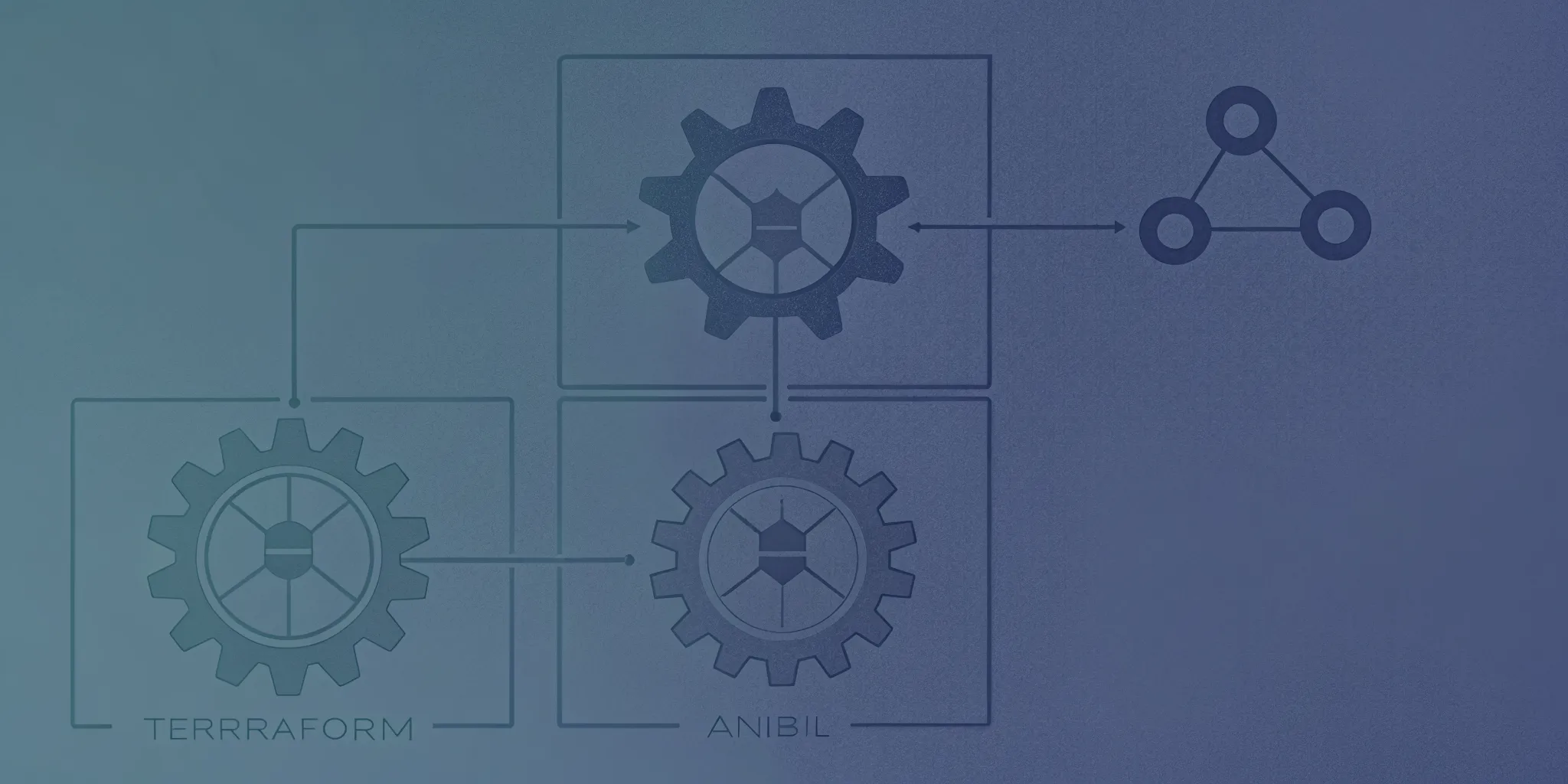
Plural's agent-based pull architecture also strengthens security. Instead of a central server pushing changes outward, local agents pull the desired state from your Git repository. This means you do not need to store private SSH keys in a centralized location. It keeps your credentials safe while delivering the full power of automated configuration management. By using Plural to manage your Ansible tasks, you can scale your operations without introducing new security risks.
Unifying IaC and Kubernetes Deployments Under One Control Plane
A unified control plane that manages both IaC tools and Kubernetes deployments eliminates operational blind spots by providing a single view of your entire infrastructure stack. Plural achieves this by combining Terraform, Pulumi, and Ansible management with Kubernetes CD, AI-powered automation, and native state storage in one platform.
Managing cloud resources and Kubernetes deployments in separate systems often creates operational friction. You use one tool for infrastructure and another for application orchestration. This division makes it difficult to maintain a complete picture of your environment. When IaC and Kubernetes CD operate in disconnected pipelines, you create blind spots. Tools like Terraform and Pulumi frequently live in isolated workflows. This makes it challenging to correlate changes between your network layer and your application layer.
The cost of disconnected workflows
A fragmented workflow costs more than just engineering time. It creates real business risk. When your cloud configuration and your cluster state fall out of sync, incidents occur. Teams often need to manage multiple sets of credentials and state files. This adds significant complexity and makes root cause analysis difficult. The goal of a secure DevSecOps strategy is to eliminate this kind of fragmentation.
Most teams waste hours on manual tasks that automated workflows could handle. They spend months on cluster upgrades that should take a day. This inefficiency keeps skilled engineers from working on high-value features. To fix this, you need a unified view of every component in your stack. You need a system that brings your infrastructure code and your application orchestration together under one operational model.
Bridging the gap with a unified control plane
Plural solves this by consolidating all your tools into a single interface. It functions as a unified IaC management platform. By applying GitOps principles across your entire infrastructure, you can treat cloud configuration exactly like application code. This approach keeps your actual state synchronized with your Git repository. It also lets you manage Terraform and Ansible within the same workflow as your Kubernetes deployments.
| Aspect | Traditional Siloed Approach | Plural Unified Approach |
|---|---|---|
| IaC Workflows | Separate tools and pipelines | Single control plane for all tools |
| State Storage | External S3 or cloud backends | Kubernetes-native state storage |
| Approval Flow | Manual or disconnected PRs | Built-in PR-driven automation |
| AI Automation | None or manual scripts | 95% of day-2 tasks automated |
| Upgrade Speed | Average 3-month cycle | Fully automated 1-day upgrades |
| Operational Cost | High manual overhead | 88% cost reduction |
This unified approach delivers approximately 30x ROI by eliminating manual toil. Your team can stop fighting tool complexity and start shipping software. With an AI-native engine, you can manage fleets of clusters efficiently. This shift transforms day-2 operations from a burden into a competitive advantage. You get better velocity, stronger security, and a significantly lower operational cost.
Building Your Unified GitOps Pipeline with Plural
Building a unified GitOps pipeline requires deploying the Plural control plane on a management cluster. Installing agents on workload clusters, connecting Git repositories for IaC and Kubernetes manifests, and enabling AI-powered automation for day-2 operations. The entire setup uses egress-only networking and self-hosted infrastructure for maximum security.
A unified GitOps pipeline helps platform teams manage multi-cloud environments with speed and security. By using GitOps across your entire infrastructure, you can ensure system state always matches your version-controlled source of truth. Plural brings these tasks together under one control plane to simplify day-2 operations.
Deploy the self-hosted control plane
The first step is to install the Plural control plane on a management cluster. Unlike traditional tools that store credentials in a centralized cloud service, Plural uses a self-hosted model to keep your data secure. This design follows the NIST DevSecOps guidelines for secure infrastructure management. You can deploy on any Kubernetes distribution in your own environment, avoiding vendor lock-in. Once live, the control plane acts as the central hub for your entire fleet.
Install agents on workload clusters
Plural uses an agent-based pull model to manage workload clusters. You install a lightweight agent on each cluster that polls the control plane for updates. This egress-only network model is a key security feature because it eliminates the need for inbound ports. The agent continuously ensures the cluster state matches your desired configuration in Git.
Connect repositories and automate
You can connect your Git repositories to Plural to manage IaC stacks and Kubernetes manifests together. Whether you use Terraform, Pulumi, or Ansible, Plural handles the complete IaC management workflow for your team. This setup enables PR-driven operations where every commit triggers a plan or apply action, ensuring full visibility across your system.
- Deploy the Plural control plane on your management cluster to create a central hub for your fleet.
- Install agents on your workload clusters using egress-only paths to pull updates without opening inbound ports.
- Connect your Git repositories to link your Terraform, Pulumi, and Ansible stacks with your Kubernetes manifests.
- Configure PR-driven workflows to trigger plan and apply actions on every code change in your repository.
- Enable AI-native features to detect anomalies and automate up to 95 percent of your day-2 operations.
Secure and scale your fleet
As your fleet expands, maintaining consistency becomes more challenging. GitOps provides a clear record of every change, making it straightforward to perform rollbacks if errors occur. By unifying your deployment workflows, you reduce the risk of configuration drift and ensure your platform remains resilient across any number of clusters.
Start your free 14-day trial and build your unified GitOps pipeline today.
Frequently Asked Questions
Can I use GitOps with Terraform, Ansible, and Pulumi for infrastructure management?
Yes. GitOps is an operational model that applies to more than just Kubernetes manifests. You can use it to manage any infrastructure by using Git as your source of truth. Platforms like Plural let you combine Terraform, Pulumi, and Ansible under a single GitOps workflow. This helps you automate operations and ensures your system matches your configuration files.
How does GitOps unify Kubernetes deployment and infrastructure as code?
GitOps unifies these domains by treating all configuration files as code subject to the same review, versioning, and reconciliation processes. It uses a pull-based model where agents monitor Git for changes. When you update a configuration file, the agent automatically applies those changes to the target environment. This creates a consistent operational model for both applications and infrastructure. By using a platform that supports both domains, you can manage your entire stack from a single interface.
Should I choose Terraform, Pulumi, or Ansible for my GitOps workflow?
The choice depends on your team's specific requirements. Terraform excels at declarative cloud resource provisioning. Pulumi lets you use general-purpose programming languages like Python and Go. Ansible is ideal for configuration management and software deployment. The key insight is that you do not have to choose just one. Modern platforms like Plural allow you to use all three within a unified workflow. This lets you select the best tool for each task while maintaining consistency across your entire infrastructure.
Does GitOps replace the need for traditional IaC tools?
No. GitOps does not replace IaC tools. It transforms how you use them. You still need Terraform to provision cloud resources and Ansible to configure servers. GitOps provides the operational framework that automates those tools. It ensures that any change committed to your repository is reflected in your live environment. This eliminates manual steps and makes your operations more reliable. It also makes it easy to audit changes through your commit history.
Start your unified GitOps workflow today
Keeping your infrastructure tools in separate silos leads to wasted engineering time and elevated risk of configuration drift. Every manual step or disconnected workflow introduces more opportunities for failure. By adopting a unified GitOps model now, your team can eliminate repetitive operational tasks and redirect focus toward building great software.
Waiting to consolidate only allows technical debt to accumulate as your fleet grows. Most teams find that moving to a unified control plane pays for itself through hours saved each week. You gain confidence knowing every change is tracked, reviewed, and tested through a consistent pipeline. Bring your infrastructure and application deployments into a single, clear operational model.

Newsletter
Join the newsletter to receive the latest updates in your inbox.